












The short answer: In 2026 the Industrial Court of NSW fined a manufacturer $450,000 after a worker was struck and run over by a forklift while helping to load a truck. The forklift was carrying a load slung from its tines, the worker was on foot in the same zone, and the two met. The case is a stark reminder that the deadliest forklift risk is rarely the driver’s skill alone — it’s pedestrians and forklifts sharing space without proper separation.
- The penalty: $450,000, imposed by the Industrial Court of NSW following a SafeWork NSW prosecution.
- What happened: a worker on foot was struck and run over by a forklift while steadying a load being loaded onto a truck, suffering serious injuries.
- The core failure: pedestrians and a moving, load-carrying forklift in the same area without effective separation.
- The fix is known: traffic management, exclusion zones, spotters, and properly licensed, competent operators.
- Licensing is the baseline: operating most forklifts requires a nationally recognised High Risk Work Licence (class LF), unit TLILIC0003.
- FMS Training delivers accredited forklift licensing in person at Lawnton, Brisbane.
What happened?
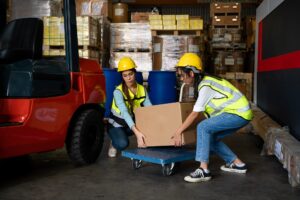
According to SafeWork NSW, the worker was on foot near the front of a forklift, helping to keep a load steady and in line as it was being loaded onto a truck. The load was slung from the forklift’s tines. During the operation the worker was struck and run over, sustaining serious injuries including fractures. The court imposed a $450,000 penalty.
The detail that matters for every workplace is not unusual: a person on foot and a moving forklift were operating in the same space at the same time. That single overlap — pedestrian and powered mobile plant sharing a zone — is behind a large share of serious forklift incidents in Australia.
Why “struck by forklift” keeps happening
Forklifts are deceptively dangerous. They’re heavy, they carry loads that block the operator’s line of sight, they can’t stop instantly, and they’re often used in busy areas where people are walking, loading and moving stock. When a load is slung or oversized, visibility drops further. Add time pressure during truck loading and the conditions for a pedestrian strike are all present.
This is why regulators consistently point to separating people from forklifts as the highest-value control — far more reliable than asking everyone to simply “be careful”.
The lesson: separate people from forklifts
The hierarchy of controls applies directly to forklift–pedestrian risk. From most to least effective:
| Control | Example | Effectiveness |
|---|---|---|
| Eliminate the overlap | Load/unload in an area with no pedestrian access | Highest |
| Engineering / isolation | Physical barriers, designated walkways, exclusion zones around active forklifts | High |
| Administrative | Traffic management plan, spotters, no-go zones during loading, hi-vis, training | Medium |
| PPE | Hi-vis clothing (supports, but never the primary control) | Lowest |
A worker helping to “steady a load” by standing next to a moving forklift is exactly the situation a good traffic management plan is meant to design out. The controls aren’t exotic — exclusion zones, a documented loading procedure, a trained spotter, and operators who know how to refuse to move while a pedestrian is in the danger zone.
Where training fits
Two layers of competence prevent this kind of incident. First, the operator must be properly licensed and genuinely competent — not just ticket-holding. Operating most forklifts in Australia requires a nationally recognised High Risk Work Licence, class LF, delivered through the unit TLILIC0003 Licence to operate a forklift truck. Quality training covers load handling, visibility limits, pedestrian awareness and safe operating procedures — the exact behaviours that keep a load-carrying forklift away from people on foot.
Second, the workplace must back the licence with systems: a traffic management plan, exclusion zones and a culture where loading stops the moment someone’s on foot in the wrong place.
FMS Training delivers accredited forklift licensing (TLILIC0003) in person at our Lawnton facility in Brisbane, with experienced assessors and real equipment. If you’re starting out, see our step-by-step guide on how to get a forklift licence in Queensland, what a forklift licence costs in Brisbane, and the difference between the LF and LO licence classes.
Frequently asked questions
How much was the forklift fine?
The Industrial Court of NSW imposed a $450,000 penalty following a SafeWork NSW prosecution after a worker was struck and run over by a forklift while loading a truck.
What is the most common cause of serious forklift incidents?
Pedestrians and forklifts sharing the same space without effective separation. Struck-by incidents during loading, reversing and in busy areas are a leading cause of serious harm.
How do you prevent pedestrians being hit by forklifts?
Separate people from forklifts using the hierarchy of controls — eliminate the overlap where possible, use physical barriers and exclusion zones, back them with a traffic management plan and spotters, and ensure operators are licensed and competent.
Do you need a licence to operate a forklift in Australia?
Yes. Operating most forklifts requires a nationally recognised High Risk Work Licence, class LF, gained through the unit TLILIC0003 Licence to operate a forklift truck.
Does a forklift licence make a workplace compliant on its own?
No. A licence proves operator competence, but the workplace must also provide traffic management, exclusion zones, safe loading procedures and supervision to control pedestrian risk.
What is a forklift exclusion zone?
A defined area around an operating forklift that pedestrians must not enter while the machine is moving or handling a load — a simple, high-value control during loading and unloading.
Where can I get an accredited forklift licence in Brisbane?
FMS Training delivers accredited forklift licensing (TLILIC0003) in person at its Lawnton facility in Brisbane, with practical assessment on real equipment.
Is a one-day forklift course enough?
Competence is what matters, not speed. A course must genuinely build safe-operating skills — including pedestrian awareness and load handling — before an operator is assessed as competent.