









Last updated: 29 October 2026
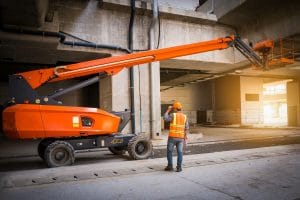
No. You do not need a Yellow Card to operate a scissor lift or any elevating work platform in Queensland. No law requires one. What the law requires is that the operator is trained and competent for the machine, and, for a boom lift with a boom of 11 metres or more, a high risk work licence from WorkSafe Queensland. The nationally recognised unit that proves your training on a scissor lift is RIIHAN301E Operate elevating work platform.
Key facts at a glance
- The Yellow Card is a voluntary industry card run by the Elevating Work Platform Association (EWPA). It is not a government licence and no Queensland law requires it.
- The Yellow Card training program says it is aligned to RIIHAN301E, the same nationally recognised unit a registered training organisation issues directly.
- Scissor lifts, vertical lifts and boom lifts under 11 metres need no licence. The business must make sure the operator is trained and competent.
- Boom lifts of 11 metres or more need a WorkSafe Queensland high risk work licence (class WP).
- Working at heights (RIIWHS204E) is a separate unit about falls. It does not cover operating the machine, but many sites ask for it as well.
Book EWP training for your team
What is a Yellow Card?
The Yellow Card is an operator card issued through a training program run by the Elevating Work Platform Association of Australia, an industry association. Its own website describes the program as training “aligned to RIIHAN301E” and lists fees for card services, such as renewing an expired card or replacing a printed one.
It is a branded card, not a qualification set by government. The nationally recognised evidence of EWP training is a Statement of Attainment for RIIHAN301E, issued by a registered training organisation.
What does the law actually require?
Under Queensland’s work health and safety law, the rules depend on the machine:
| Machine | What the law requires | Yellow Card required? |
|---|---|---|
| Scissor lift (any height) | Operator trained and competent. No licence. | No |
| Vertical (mast) lift | Operator trained and competent. No licence. | No |
| Boom lift, boom under 11 metres | Operator trained and competent. No licence. | No |
| Boom lift, boom 11 metres or more | High risk work licence, class WP, from WorkSafe Queensland | No (the WP licence is what is required) |
Safe Work Australia’s guidance says the same thing for machines that need no licence: the business must make sure operators “know how to operate them safely with the right training, information and instruction”. A nationally recognised RIIHAN301E Statement of Attainment is the clearest way to show that.
Your site asked for a Yellow Card? Some builders and hire companies write “Yellow Card” in their site rules because it is a familiar name. That is a site preference, not the law. Ask whether they will accept a RIIHAN301E Statement of Attainment from a registered training organisation. Many do. If a site insists on the card, that is their rule to set, so check before you book.
Do I need a working at heights ticket to use an EWP?
Working at heights (RIIWHS204E Work safely at heights) is about preventing falls: harnesses, anchor points and safe work at height. It does not teach you to operate a scissor lift or boom lift. The machine needs its own training (RIIHAN301E, or the WP licence for booms of 11 metres or more).
Many sites ask for both, because working from an EWP basket is still work at height. If you are not sure what your site needs, ask for the list of tickets in writing before you book anything.
Why businesses choose FMS Training for EWP training
- We come to you. Training at your workplace across South East Queensland, on your own scissor lift or EWP.
- Nationally recognised. Your team receives a RIIHAN301E Statement of Attainment, with no separate card fee and no card to renew.
- One visit, several tickets. Ask about adding working at heights for the same team.
- A trusted local trainer. Outstanding Education Service winner at the 2025 and 2026 Moreton Bay Local Business Awards, with a 4.9-star Google rating.
How much does EWP training cost at FMS Training?
| Course | Covers | Price |
|---|---|---|
| RIIHAN301E Operate elevating work platform | Scissor lifts, vertical lifts, booms under 11 metres | $360 per person, onsite for groups |
| TLILIC0005 Licence to operate a boom-type EWP (WP) | Booms of 11 metres or more | $550 per person, onsite for groups (WorkSafe licence fee paid separately to WorkSafe) |
| RIIWHS204E Work safely at heights | Fall protection | $310: theory online, then a practical session at Lawnton |
There is no separate card fee and no card to renew. You receive a nationally recognised Statement of Attainment from FMS Training, RTO 45189.
Operate elevating work platform (RIIHAN301E), Nationally recognised, RTO 45189, 4.9-star Google rating.
$360 per person. Delivered at your workplace across South East Queensland for group bookings; group discounts may apply for more than 6 people. Booking for yourself? Phone 1300 699 150.
Book EWP training for your team
Frequently asked questions
Is a Yellow Card a licence?
No. It is a voluntary industry card. The only government licence for EWPs in Queensland is the high risk work licence (class WP) for boom lifts of 11 metres or more.
Do I need a licence to drive a scissor lift?
No. There is no licence for scissor lifts. You must be trained and competent, which is usually shown with a RIIHAN301E Statement of Attainment.
Is RIIHAN301E the same training as the Yellow Card?
The Yellow Card program says its training is aligned to RIIHAN301E. A RIIHAN301E Statement of Attainment from a registered training organisation is the nationally recognised record of that training.
Does a working at heights ticket cover a scissor lift?
No. Working at heights covers fall protection. Operating the machine needs RIIHAN301E, or the WP licence for booms of 11 metres or more.
Is the Queensland “yellow card” for disability workers the same thing?
No. Queensland also uses the name “yellow card” for disability worker screening. That has nothing to do with elevating work platforms.