


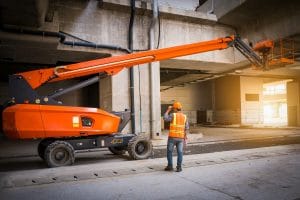












A forklift VOC (Verification of Competency) is an assessment that confirms a current LF licence holder can still operate safely. Employers commonly require one for new hires, site inductions, returns from extended leave, or after an incident. It is not a licence, and it does not renew or reinstate one — it verifies competency for your workplace.
Key facts at a glance
- What it is: a short knowledge + practical assessment verifying that a licensed operator remains competent.
- Who it’s for: people who already hold a current LF high risk work licence — a VOC cannot substitute for the licence itself.
- Why it exists: under work health and safety law, an employer cannot simply assume a worker is competent — a VOC is documented evidence.
- Typical duration: around 1–2 hours, depending on experience and workplace requirements.
- What you get: a record of competency for your employer’s records — it does not change your WorkSafe licence or its expiry.
- Where: FMS Training (RTO 45189) runs forklift VOC assessments at our Lawnton training centre (north Brisbane) or onsite at your workplace — with online assessment via live video link coming in August 2026, Australia-wide.
What is a forklift VOC?
A Verification of Competency is a structured assessment — usually a knowledge check plus a practical demonstration — that measures a licensed forklift operator against the current competency benchmarks for the LF licence class (unit of competency TLILIC0003). The outcome is documented evidence that, on the day of assessment, the operator worked safely: pre-start checks, load assessment, safe travel, stacking and shutdown. Think of it as an audit of skills you already hold, not new training.
Why do employers ask for a VOC?
Because the law puts the burden on them. Under the Work Health and Safety Act, a person conducting a business or undertaking must ensure, so far as is reasonably practicable, that workers are trained and competent for the work they do — and a licence card issued years ago doesn’t prove current competency on its own. A documented VOC is the cleanest way for an employer to discharge that duty, which is why principal contractors, mines and large logistics sites often make it a standing induction requirement.
When do you actually need one?
Common triggers include:
- Starting a new job — especially through labour hire, where the host employer needs its own evidence of competency.
- Site inductions — many principal contractors and resource-sector sites require a VOC before any high risk work.
- Returning to work after extended leave, injury or a long stretch away from forklift duties.
- After an incident or near miss involving the operator or their equipment.
- Changing equipment or tasks — a different truck type, attachments, or a new operating environment.
- Company policy — many employers re-verify all operators on a fixed cycle, commonly every one to two years.
VOC vs refresher vs renewal: what’s the difference?
These three get mixed up constantly, and choosing the wrong one wastes time and money. Here is the plain-English distinction:
| Option | Who it’s for | What it does | What it does NOT do |
|---|---|---|---|
| VOC | Current LF licence holders | Verifies you are still competent; gives your employer documented evidence | Doesn’t renew your licence or change its expiry |
| Refresher course | Current LF licence holders who feel rusty | Rebuilds skills and confidence with an instructor before you’re assessed or return to duties | Doesn’t renew your licence; isn’t a formal VOC record unless assessed as one |
| Licence renewal | Holders of a licence nearing its 5-year expiry | Extends your high risk work licence — applied for online through WorkSafe Queensland | Involves no re-testing while the licence is current |
| Full course | New operators — and anyone whose licence has been expired more than 12 months | Complete TLILIC0003 training and assessment leading to a new licence application | Can’t be skipped via a VOC or refresher once a licence has lapsed |
Important: a VOC is never a shortcut back to a lapsed licence. If your LF licence has been expired for more than 12 months, WorkSafe Queensland requires you to complete the full course and assessment again. If it’s still current, renew it online through WorkSafe Queensland’s High Risk Work Licence online services — then a VOC simply evidences your ongoing competency for your employer.
What happens during a forklift VOC assessment?
Expect a focused session of around one to two hours. You’ll complete a knowledge assessment covering safe operating procedures, load capacity and stability, hazard identification and site rules, then demonstrate practical operation: pre-operational checks, safe start-up, manoeuvring, picking up, carrying and placing loads, working near pedestrians, and parking and shutdown. The assessor measures your performance against the current LF benchmarks and your workplace’s requirements. If a gap shows up, that’s a good outcome, not a failure — it tells you exactly what to practise, and a refresher course can close the gap before re-assessment.
What should you bring on the day?
Bring your current high risk work licence (the assessor must sight it — a VOC can’t proceed without a valid LF licence), photo identification, and standard personal protective equipment: enclosed steel-capped boots, high-visibility clothing and long pants. If your employer has specific procedures they want assessed against, have them send those through when booking.
Where can you do a forklift VOC?
FMS Training (RTO 45189) runs forklift VOC assessments at our purpose-built training facility at Lawnton, north Brisbane — the same centre that delivers our nationally recognised forklift licence course (TLILIC0003) — or onsite at your workplace for employers verifying whole teams. From August 2026, VOC assessments will also be available online via live video link, Australia-wide, making re-verification practical for regional and multi-site workforces. With 1,388 Google reviews (4.9 stars), we assess operators for individual job seekers, labour-hire agencies and employers alike. And if your licence has lapsed past the 12-month mark, our guide to forklift licence renewal in Queensland explains the path back.
Frequently asked questions
What does VOC stand for in forklift operation?
Verification of Competency — a documented assessment confirming that a current LF licence holder can still operate a forklift safely and to the current competency benchmarks.
Is a forklift VOC a legal requirement?
The VOC itself is not named in legislation, but employers must ensure workers are competent under work health and safety law, and a documented VOC is the standard way to evidence that. Many sites make it a mandatory induction requirement.
Do I need a forklift licence before I can do a VOC?
Yes. A VOC verifies the competency of someone who already holds a current LF high risk work licence. It is not a licence, and it cannot replace one.
Does a VOC renew my forklift licence?
No. A VOC does not change your licence or its expiry date. Licence renewal is a separate process completed online through WorkSafe Queensland before your licence’s 5-year expiry.
Can I do a VOC if my forklift licence has expired?
No. A VOC requires a current licence. If your licence has been expired for more than 12 months, WorkSafe Queensland requires you to complete the full course and assessment again.
How long does a forklift VOC take?
Typically around 1–2 hours, covering a knowledge assessment and a practical demonstration. The exact duration depends on your experience and any workplace-specific requirements being assessed.
How often should forklift operators be re-verified?
There is no legislated interval, but many employers re-verify operators every one to two years, after incidents, or when operators change equipment, tasks or sites.
What happens if I don’t pass a VOC?
You are not penalised and your licence is unaffected. The assessment identifies the skill gaps, and a refresher course with an instructor prepares you to be re-assessed successfully.
Sources: WorkSafe Queensland — Licences for high risk work · training.gov.au — TLILIC0003 Licence to operate a forklift truck · Safe Work Australia — High risk work licences