














Psychological first aid is the immediate, practical and emotional support given to someone who is distressed after a crisis, accident or traumatic event. It centres on safety, calm listening and connecting the person with further help — not diagnosis or therapy. In Australia, it is taught as a nationally recognised unit of competency, PUARCV001.
If you need support now: this article is general information, not clinical advice. Lifeline is available 24/7 on 13 11 14, and you should call 000 in an emergency.
Key facts at a glance
- What it is: immediate, non-clinical support for someone in psychological distress.
- Endorsed by: the World Health Organization, and used across Australian emergency, health and community services.
- What it is not: counselling, diagnosis, therapy or formal debriefing.
- Who can learn it: managers, HR and safety staff, first responders, teachers and community workers — no clinical background required.
- Accredited unit in Australia: PUARCV001 — Provide psychological first aid, delivered by registered training organisations.
- FMS delivery: online, self-paced and available nationwide through RTO 45189.
What does psychological first aid actually mean?
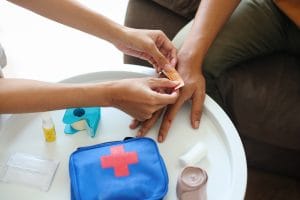
Psychological first aid works the same way physical first aid does. When someone is physically hurt, a first aider doesn’t operate — they stop the bleeding, keep the person calm and get them to proper care. Psychological first aid applies that logic to psychological distress. After an accident, a death, a disaster, an act of violence or any frightening event, a person may be shocked, tearful, numb or overwhelmed. Psychological first aid is the calm, structured way a trained person helps them feel safe in the hours that follow, without trying to fix or treat them.
The approach was developed by the World Health Organization for disaster and emergency settings, and has since spread across health, education, emergency services and workplaces worldwide. It is deliberately built for non-specialists — which is why it now sits alongside physical first aid as a workplace skill, and why FMS Training delivers it as the accredited Psychological First Aid course (PUARCV001) online, nationwide.
What is psychological first aid NOT?
Most hesitation about psychological first aid comes from not knowing where its boundaries sit. The table below sets that out.
| Psychological first aid IS | Psychological first aid is NOT |
|---|---|
| Immediate, practical and emotional support | Counselling or psychotherapy |
| A skill any trained adult can use | A clinical diagnosis of mental illness |
| Calm listening, without pressure to talk | Formal psychological debriefing |
| Connecting a person with appropriate help | A substitute for professional treatment |
The World Health Organization summarises this scope of action under three broad headings — Look, Listen, Link — which accredited training covers in full. This page focuses on what psychological first aid is, not on how to deliver it.
Who is psychological first aid for?
Psychological first aid is not limited to first responders or clinicians. In Australian workplaces it has become a mainstream capability, because psychosocial-hazard laws now require employers to manage risks to psychological health, not just physical safety. People who typically train in it include:
- Managers and supervisors, often the first to notice a team member in distress
- HR, health and safety, and wellbeing officers
- First responders, healthcare and aged-care workers
- Teachers and community or frontline service staff
- Anyone in a high-risk industry such as construction, transport or emergency services
No clinical background is required. PUARCV001 has no formal prerequisites, which is part of why becoming an accredited psychological first aider is realistic for almost any workplace.
When is psychological first aid used?
Psychological first aid is used in the minutes, hours and days immediately after a distressing event — not weeks or months later, when a person’s needs shift toward ongoing clinical care. Common triggers include workplace accidents and injuries, sudden deaths, natural disasters, violence or threats, and any incident that leaves someone shocked, frightened or overwhelmed. The goal in that window is stabilisation and connection to appropriate support, not resolution of the underlying event.
Why does accreditation matter in psychological first aid?
Anyone can offer basic human kindness after a crisis, and that matters. But workplaces, healthcare, education, aged care and community services increasingly need documented evidence that a named person can respond — not just goodwill. That’s what accreditation provides.
In Australia, the nationally recognised unit of competency is PUARCV001 — Provide psychological first aid, listed on the national training register at training.gov.au. It is delivered by registered training organisations and assessed against a defined standard, and successful completion leads to a nationally recognised Statement of Attainment — evidence that holds up under audit or regulatory scrutiny in a way an attendance certificate does not. For more, see is psychological first aid accredited in Australia.
FMS Training (RTO 45189) delivers the accredited PUARCV001 course online and self-paced, available nationwide without a classroom day.
How does psychological first aid apply in the workplace?
Psychological first aid has moved from a disaster-response niche into everyday workplace risk management. Australian work health and safety regulators now treat psychological harm as a foreseeable, manageable risk, and expect employers to have people capable of responding when something goes wrong — an injury, an aggressive incident, a bereavement, or a difficult period for a team member. Building that capability in-house is a direct way to demonstrate an organisation takes psychosocial hazards at work seriously.
How is psychological first aid different from mental health first aid?
The two phrases are often used interchangeably, but in the Australian training market they are not the same thing. Psychological first aid — and specifically PUARCV001 — is a nationally recognised VET unit focused on immediate support during and after a crisis. Mental Health First Aid is a separately branded program focused on recognising and responding to mental health problems more broadly, and it is not itself an accredited VET qualification. If you’re weighing the two up, our detailed comparison covers Mental Health First Aid vs Psychological First Aid in full.
How do you become accredited in psychological first aid?
Accredited training is delivered against PUARCV001 by a registered training organisation. FMS Training delivers it 100% online and self-paced, so it’s accessible from anywhere in Australia. On successful completion you receive a nationally recognised Statement of Attainment.
FMS also offers a shorter, non-accredited introduction for workplaces that want to build awareness first. It is a separate course that does not lead to a Statement of Attainment — see the non-accredited Psychological First Aid course for details, or choose the accredited program below if you need the nationally recognised unit.
Ready to train? Explore the accredited Psychological First Aid course (PUARCV001), delivered online and nationwide by RTO 45189.
Frequently asked questions
What is psychological first aid?
Psychological first aid is the immediate, practical and emotional support given to someone in distress after a crisis, accident or traumatic event. It focuses on safety, calm listening and connecting the person with further help, rather than diagnosis or treatment.
What are the WHO’s psychological first aid principles called?
The World Health Organization summarises its guidance as Look, Listen, Link — broad categories of action that accredited training covers in detail, rather than a script for what to say.
Is psychological first aid the same as counselling or therapy?
No. Psychological first aid does not diagnose or treat mental illness and is not a substitute for professional counselling or therapy. It is immediate, non-clinical support in the period right after a distressing event.
Who provides psychological first aid in an Australian workplace?
Typically managers, supervisors, HR and safety staff, or any trained team member — not just clinicians. It is deliberately designed to be delivered by non-specialists.
When should psychological first aid be used?
In the minutes, hours and days immediately after a crisis, accident, death, disaster or other distressing event, when a person needs stabilisation and connection to help rather than ongoing clinical care.
Is psychological first aid accredited in Australia?
Yes. The nationally recognised unit is PUARCV001 — Provide psychological first aid, delivered by registered training organisations and listed on the national training register.
What’s the difference between psychological first aid and mental health first aid?
Psychological first aid (PUARCV001) is a nationally recognised VET unit focused on immediate support during and after a crisis. Mental Health First Aid is a separately branded program focused on recognising mental health problems more broadly, and is not itself an accredited VET qualification.
How do you get accredited in psychological first aid?
By completing PUARCV001 with a registered training organisation. FMS Training delivers it online and self-paced, nationwide, leading to a nationally recognised Statement of Attainment on successful completion.
Sources: World Health Organization, Psychological First Aid: Guide for Field Workers — who.int · training.gov.au — PUARCV001 Provide psychological first aid.