











Keep pedestrians safe around forklifts by physically separating people from powered mobile plant — exclusion zones, barriers, one-way traffic flows and safe systems of work — backed by trained, licensed operators. Regulators have now named mobile plant a formal 2026 enforcement priority, making forklift–pedestrian separation a frontline compliance issue for every site.
Key facts at a glance
- Forklifts are classed as “powered mobile plant” under work health and safety law.
- A PCBU (employer/business) must manage plant-pedestrian collision risk so far as is reasonably practicable.
- SafeWork NSW’s 2026–27 Regulatory Statement names mobile plant, vehicles and fixed machinery as an explicit enforcement priority.
- Operating a forklift requires a current LF High Risk Work Licence (national unit TLILIC0003), even in a private workplace.
- A licence proves general competence; a site-specific Verification of Competency (VOC) confirms an operator is safe on that equipment, on that site.
- FMS Training delivers the forklift licence course in person at Lawnton, Brisbane.
Why are forklift–pedestrian collisions such a serious risk?
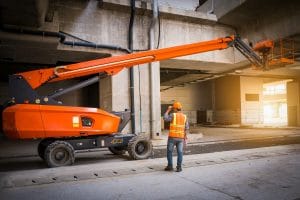
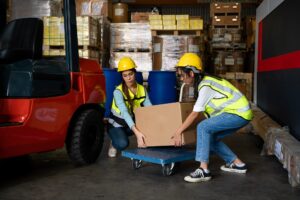
A loaded forklift can weigh several tonnes, has restricted visibility around the mast and load, and cannot stop or swerve like a car. Share that floor space with people on foot — in a warehouse, distribution centre or construction site — and a single misjudged reverse or blind corner can be severe. Forklift–pedestrian incidents remain a consistently reported cause of serious workplace injury in Australia, which is why regulators keep returning to mobile plant as an enforcement focus.
What are regulators focusing on in 2026?
On 1 July 2026, SafeWork NSW released its 2026–27 Regulatory Statement, resetting its compliance priorities. Alongside falls from heights, psychosocial risks and hazardous substances such as silica and asbestos, the statement names mobile plant, vehicles and fixed machinery as an explicit enforcement priority, citing high incident volumes. Forklifts sit squarely inside “mobile plant” — so pedestrian separation, safe systems of work and licensing compliance are more likely to be tested this year, not less.
What happened at the Royal Australian Mint?
Comcare reported on 23 June 2026 that the Royal Australian Mint had entered an enforceable undertaking involving more than $1 million in work health and safety improvements. The undertaking followed a 2019 incident in which a coin blanking press weighing about three tonnes almost fell on a worker during a forklift move. Note the distinction: this is an enforceable undertaking, not a court-imposed fine — a negotiated commitment to remediate rather than a penalty. It specifically covers contractor induction, mobile-plant traffic management, lift planning, plant moves and forklift–pedestrian separation — a clear, recent example of a regulator treating separation as a system-wide obligation, not a one-off toolbox talk.
How do you separate forklifts and pedestrians?
At a duty level, separation means designing the workplace so people and powered mobile plant don’t have to share the same space and time unnecessarily. That typically includes physical barriers and dedicated walkways, clearly marked exclusion zones around loading and manoeuvring areas, one-way or controlled traffic flows, and safe systems of work — signage, horns, mirrors, right-of-way rules and supervision — where full physical separation isn’t reasonably practicable. This article deliberately doesn’t walk through how to design a site traffic management plan; that’s a site-specific exercise for whoever holds the WHS duty.
Do forklift operators need a licence?
Yes. Operating a forklift is high risk work, and an operator must hold a current LF High Risk Work Licence — national unit TLILIC0003 — before they operate one, including in a private workplace with no public access. It’s a legal precondition, not a discretionary certificate. FMS Training delivers the forklift licence course in person at Lawnton, Brisbane.
What is a Verification of Competency (VOC)?
A licence confirms an operator has met the national training standard. It doesn’t confirm they know your site, your equipment or your traffic rules. That’s what a Verification of Competency does: a practical, employer-led check that a currently licensed operator can safely operate a specific forklift in a specific environment. Many workplaces run a VOC for every new or returning operator, and again whenever equipment or layout changes. See our dedicated VOC explainer for the detail.
Who is responsible for forklift safety on site?
Under WHS law, the primary duty sits with the PCBU (the business) to manage the risk of collision between mobile plant and pedestrians so far as is reasonably practicable — covering site design, traffic management, supervision and ensuring only competent, licensed people operate plant. Operators carry a parallel duty to hold a current licence, follow site rules and take reasonable care. Responsibility is shared, but the system that makes separation work — the layout, the rules, the training — is the PCBU’s to build.
How does training reduce the risk?
Training reduces risk in two ways. Licensing (TLILIC0003) builds core competence — safe operating procedures, load handling, hazard awareness and the fundamentals of working safely around pedestrians. VOC then translates that competence into a specific site, confirming the operator understands the traffic flow, exclusion zones and equipment before they’re relied on in practice.
| Common forklift–pedestrian risk scenario | Primary control category |
|---|---|
| Forklift reversing near foot traffic | Separation / exclusion zone |
| Blind corners, doorways and intersections | Safe system of work (mirrors, horns, right-of-way rules) |
| Shared loading dock with pedestrians | Physical separation (barriers, dedicated walkways) |
| New, casual or visiting operators on site | Verification of Competency + supervision |
| Multiple mobile plant operating together | Traffic management plan / spotter systems |
| Operator unfamiliar with a specific site or machine | Verification of Competency (VOC) |
Key takeaway: A current LF licence proves an operator can operate a forklift. Site-specific traffic management and a Verification of Competency prove they can do it safely *here* — on this site, with this equipment, around these pedestrians. In 2026, with mobile plant a named regulator priority, businesses need to be able to show both.
Frequently asked questions
How do you keep pedestrians safe around forklifts?
Keep pedestrians safe by physically separating people from forklifts wherever possible — exclusion zones, barriers and controlled traffic flows — backed by safe systems of work and operators who hold a current licence and site-specific competency.
Do I need a licence to operate a forklift at my own workplace?
Yes. A current LF High Risk Work Licence (TLILIC0003) is required to operate a forklift, even in a private workplace with no public access.
What is TLILIC0003?
TLILIC0003 is the national unit of competency for licensing to operate a forklift truck, leading to the LF High Risk Work Licence.
Is a forklift licence enough, or do I also need a VOC?
A licence confirms general competence to the national standard. A Verification of Competency (VOC) confirms an operator can safely work a specific machine on a specific site, and is commonly required on top of the licence.
What is mobile plant, and why is it a 2026 regulatory priority?
Mobile plant includes machinery such as forklifts. SafeWork NSW’s 2026–27 Regulatory Statement, released 1 July 2026, names mobile plant, vehicles and fixed machinery as an explicit enforcement priority due to high incident volumes.
Who is legally responsible for forklift-pedestrian safety — the employer or the operator?
Responsibility is shared. The PCBU (business) must manage collision risk so far as reasonably practicable, while operators must hold a current licence and follow site safety rules.
What happened in the Royal Australian Mint case?
Comcare reported in June 2026 that the Mint entered an enforceable undertaking worth more than $1 million in WHS improvements, following a 2019 forklift-move incident, covering traffic management and pedestrian separation.
Where can I do a forklift licence course near Brisbane?
FMS Training delivers the forklift licence course in person at Lawnton, Brisbane, leading to the LF High Risk Work Licence (TLILIC0003).
Sources
- SafeWork NSW: SafeWork NSW redefines its priorities in new 2026–27 Regulatory Statement
- Comcare: Undertaking to deliver safety overhaul at the Mint
- Safe Work Australia: Forklifts safety topic
- training.gov.au: TLILIC0003 — Licence to operate a forklift truck
Related reading
- Forklift fines: pedestrian prosecutions
- Company director fined over forklift incident
- What is a Verification of Competency (VOC)?
Get licensed at Lawnton
If you or your team need a current LF High Risk Work Licence, FMS Training — a nationally recognised Registered Training Organisation (RTO 45189), rated 4.9★ across 1,388 reviews — runs the forklift licence course in person at our Lawnton campus in Brisbane, training operators against the nationally recognised unit TLILIC0003. Explore the forklift training course and get your operators licensed and site-ready.