


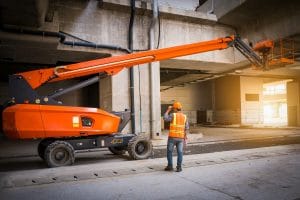







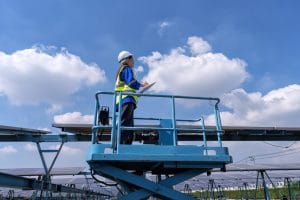

Working at Heights training and an EWP ticket are not the same thing, and most people who need one need the other too. Working at Heights is the nationally recognised unit RIIWHS204E Work safely at heights — fall-protection training for anyone working where there’s a risk of falling, including from an elevating work platform (EWP) basket. An “EWP ticket” only covers operating the machine: scissor lifts, vertical lifts and boom-type EWPs under 11 metres need no licence, just a trained and competent operator, while boom-type EWPs of 11 metres or more legally require a WP class High Risk Work Licence. If there’s a fall risk, Working at Heights training protects the person — an EWP ticket only covers the machine.
Key facts at a glance
- RIIWHS204E Work safely at heights is nationally recognised fall-protection training for any work with a fall risk — not a machine-operating licence.
- Scissor lifts, vertical lifts and boom-type EWPs under 11 m need no High Risk Work Licence — just a trained and competent operator, per WorkSafe Queensland.
- Some businesses ask for a voluntary industry credential as evidence of training. Holding one is not a legal requirement.
- Boom-type EWPs of 11 m or more legally require a WP class High Risk Work Licence (WorkSafe Queensland).
- Working from an EWP basket is still work at height — many employers require Working at Heights training alongside the operating ticket.
- FMS Training delivers RIIWHS204E in person at our Lawnton, Brisbane facility.
What is Working at Heights training (RIIWHS204E)?
RIIWHS204E Work safely at heights is a nationally recognised unit of competency covering fall hazard identification and safe work wherever there’s a risk of falling — a roof, a scaffold, a ladder, an unprotected edge, or an EWP basket. It covers selecting and inspecting fall-protection equipment such as harnesses, lanyards and anchor points, following a safe system of work, and responding if something goes wrong.
RIIWHS204E is fall-protection training, not a machine-operating licence — it applies regardless of what, if anything, you’re standing on. Safe Work Australia’s model Code of Practice: Managing the risk of falls at workplaces underpins why this matters: falls remain one of the most common causes of serious workplace injury and death in Australia.
What is an EWP ticket, and do I need one?
“EWP ticket” is shorthand for what’s required to operate an elevating work platform. What you need depends on the machine, and the dividing line is boom length.
Scissor lifts, vertical lifts and boom EWPs under 11 m
There is no statutory High Risk Work Licence for scissor lifts, vertical lifts or boom-type EWPs under 11 metres. WorkSafe Queensland’s guidance on plant that doesn’t require a licence is clear: the business still has a duty to provide the training, instruction and supervision needed to keep operators safe. In practice, that means an operator must be trained and competent — commonly evidenced through the unit RIIHAN301E — before running the machine. Some businesses ask for a voluntary industry credential as proof of training; it’s an option, not a legal requirement, and FMS Training does not issue it.
Boom-type EWPs of 11 m or more — WP High Risk Work Licence
WorkSafe Queensland’s licensing guidance is direct: to operate a boom-type elevating work platform, you need a WP high risk work licence. Boom length is the greater of the vertical distance from the supporting surface to the platform floor at maximum height, or the horizontal distance from the boom’s rotation point to the platform’s outer edge at maximum extension — and elevated work platforms under 11 metres are not included in that definition. Unlike the optional credential used for smaller machines, the WP licence is a genuine legal requirement.
A common myth: some workers are told a “Yellow Card” is legally required to run a scissor lift or an EWP under 11 m. It isn’t. It’s a voluntary industry credential some businesses choose as evidence of training — the actual legal duty is simply that the operator is trained and competent.
Working at Heights vs EWP — side by side
| Working at Heights (RIIWHS204E) | EWPs under 11 m | Boom EWP 11 m+ | |
|---|---|---|---|
| What it is | Fall-protection training | No licence — trained-and-competent duty | Statutory High Risk Work Licence |
| Covers | Any work with a fall risk | Operating scissor, vertical and boom lifts under 11 m | Operating boom-type EWPs of 11 m+ |
| Legally required? | Yes, where a fall risk exists | No licence; competency is required | Yes — mandatory to operate |
| Underlying unit | RIIWHS204E | RIIHAN301E (commonly used) | WP class HRWL unit |
| Operates the machine? | No | Yes | Yes |
Do I need Working at Heights training to operate an EWP?
Often, yes. Being trained and competent to operate an EWP lets you run the platform; it doesn’t replace fall-protection training. Working from the basket of a scissor lift or boom lift is still working at height with a fall risk, so a safe system of work still applies — that’s what RIIWHS204E delivers. Many employers require both EWP competency and current Working at Heights training before a worker sets foot on site; our guide to Queensland’s working at heights regulations covers the underlying duties.
Which one should you book?
Work backwards from the task:
- Climbing, roof work, scaffolds, ladders, edges, or working from an EWP basket? You need Working at Heights (RIIWHS204E) for fall protection.
- Operating a scissor lift, vertical lift or a boom lift under 11 m? You need a trained and competent operator — no licence, but genuine competency-based training.
- Operating a boom-type EWP reaching 11 m or more? You need a WP High Risk Work Licence — and, where there’s a fall risk, Working at Heights training as well.
FMS Training delivers RIIWHS204E Work safely at heights in person at our Lawnton facility in Brisbane, with experienced assessors and real fall-protection equipment. See our companion guide, Working at Heights Ticket Brisbane: Course, Cost & Requirements, or check how often a refresher is recommended. Ready to book? Start with our Working at Heights course in Brisbane.
Frequently asked questions
Is a working at heights ticket the same as an EWP ticket?
No. Working at Heights (RIIWHS204E) is fall-protection training for any work with a fall risk. An EWP ticket relates to operating an elevating work platform. They cover different things and are often both needed.
Do I need working at heights training to use a scissor lift or boom lift?
Usually yes. Operator training covers running the machine, but working from a raised platform is still working at height with a fall risk, so fall-protection training (RIIWHS204E) typically still applies.
Is a Yellow Card legally required for an EWP under 11 metres?
No. The EWPA Yellow Card is a voluntary industry credential, not a legal requirement. The actual legal duty is that the operator is trained and competent, commonly evidenced through training such as RIIHAN301E.
What is the 11-metre rule for EWPs?
Boom-type elevating work platforms with a boom length of 11 metres or more require a WP High Risk Work Licence, per WorkSafe Queensland. Platforms under 11 metres — including scissor and vertical lifts — are not included in that definition.
Do I need a licence to operate a scissor lift?
No High Risk Work Licence is required for a scissor lift. The employer still has a duty to ensure the operator is trained and competent, typically through recognised operator training rather than a statutory licence.
How long is a working at heights ticket valid?
The nationally recognised unit does not legally expire, but employers and site rules commonly require a refresher to keep competency current — see our guide on how often a refresher is recommended.
How old do I need to be to get a WP High Risk Work Licence?
You must be at least 18 to hold a WP class High Risk Work Licence to operate a boom-type EWP of 11 metres or more.
Where can I do Working at Heights training in Brisbane?
FMS Training delivers RIIWHS204E Work safely at heights in person at our Lawnton facility in Brisbane, with practical assessment using real fall-protection equipment.
Sources: WorkSafe Queensland — Boom type elevating work platform – WP · WorkSafe Queensland — When don’t I need a licence? · Safe Work Australia — Model Code of Practice: Managing the risk of falls at workplaces.