












Australian courts have now handed down at least four major forklift-pedestrian penalties in under a year — $330,000 against JBS Australia in NSW, $200,000 against D’Orsogna in Victoria, a second conviction for Queensland’s Drake Trailers, and a $450,000 fine against Steel-Line in March 2026. The common thread in every case: pedestrians and forklifts sharing the same space.
Key facts at a glance
- JBS Australia Pty Ltd was convicted and fined $330,000 in the District Court of NSW (announced 4 November 2025) after a worker suffered severe leg injuries when struck by a forklift in a chilled storage area.
- D’Orsogna Limited was convicted and fined $200,000 in the Melbourne County Court (17 December 2025) after a reversing forklift struck a team leader and pinned her legs to the ground.
- Drake Trailers Pty Ltd was fined $75,000 with a conviction recorded in Queensland’s Richlands Magistrates Court — its second forklift prosecution — after a reversing forklift ran over a worker’s foot at its Wacol workplace.
- WorkSafe Victoria reported 145 people injured by forklifts at work in 2025 alone.
- SafeWork NSW lists mobile plant, including forklifts, as a leading cause of traumatic injuries and fatalities and a stated 2025–26 regulatory priority.
- In none of these cases was the forklift operator’s licence the failure — every prosecution turned on missing pedestrian separation and traffic management.
What are the latest forklift prosecutions?
Court lists across three states tell a remarkably consistent story. Each of the cases below was prosecuted under section 32 of the relevant work health and safety legislation (or its Victorian equivalent) for failing the primary duty to keep workers safe so far as is reasonably practicable.
| Company | Court and state | Penalty | What happened | The failure the court found |
|---|---|---|---|---|
| JBS Australia Pty Ltd | District Court of NSW | $330,000 | Worker struck by a forklift in a chilled meat-storage area (July 2022), suffering severe left-leg injuries | Failure to comply with the section 19(1) duty to workers in an area where forklifts and pedestrians interacted |
| D’Orsogna Limited | Melbourne County Court (Vic) | $200,000 | Reversing forklift swung across a dispatch chiller and pinned a team leader’s legs (April 2023), causing a complex foot fracture | No traffic management plan, no barriers, bollards or marked walkways — the system relied on eye contact between drivers and pedestrians |
| Drake Trailers Pty Ltd | Richlands Magistrates Court (Qld) | $75,000, conviction recorded | Reversing forklift ran over a worker’s foot in a pallet-racking area (June 2022), fracturing his ankle | No exclusion zones, barriers or rules separating pedestrians from operating forklifts — despite a prior forklift prosecution roughly a decade earlier |
| Steel-Line Garage Doors Australia Pty Ltd | Industrial Court of NSW | $450,000 | Worker seriously injured when struck by a forklift while a truck was being loaded (October 2022) | Inadequate pedestrian protection — covered in our $450,000 forklift fine report |
What do these cases have in common?
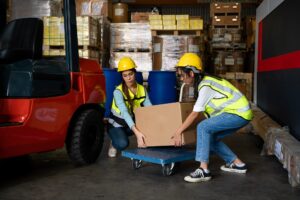
None of these prosecutions was about a rogue, unlicensed driver. In each case, licensed work was being done in an ordinary warehouse, chiller or factory — and the court found the business had not physically or procedurally separated people from moving forklifts. In D’Orsogna’s case, WorkSafe Victoria told the court the entire system for avoiding collisions was forklift drivers and pedestrians “making eye contact”. Acting Chief Health and Safety Officer Barb Hill called that “an appalling approach to safety on a well-known risk”.
The Drake Trailers case adds a second lesson: courts treat repeat incidents severely. The company had been prosecuted over a forklift incident about ten years earlier, had itself identified forklifts in the same area as a significant risk weeks before the 2022 incident, and had planned controls — but never implemented them. The magistrate recorded a conviction specifically because of the prior offending.
Why are regulators targeting forklift incidents?
Because the numbers keep justifying it. WorkSafe Victoria reported 145 forklift injuries at work in 2025 alone. SafeWork NSW says injuries from mobile plant, vehicles and fixed machinery — including forklifts — remain a leading cause of traumatic injuries and fatalities in NSW workplaces, and has named workers operating and working around mobile plant a priority in its 2025–26 regulatory program. Queensland’s dedicated Work Health and Safety Prosecutor publishes forklift court reports with the same recurring theme: pedestrians and plant in shared spaces.
Regulators’ own guidance to employers after these cases is consistent and simple: have a current traffic management plan, physically separate pedestrians from moving machinery, and ensure everyone operating equipment holds the appropriate high risk work licence.
Queensland employers take note: Drake Trailers shows how a recorded conviction follows a company that has been warned before. A prior incident — even a decade old — will be front and centre at sentencing.
What does this mean for employers who use forklifts?
The legal baseline hasn’t changed: operating a forklift in Australia requires a high risk work (LF) licence, obtained through the nationally recognised unit TLILIC0003. But these prosecutions show the licence is the start of an employer’s duty, not the end of it. Businesses are being fined six figures for the system around the forklift — and courts are asking employers to prove not just that operators were licensed, but that they were verifiably competent for the site, the equipment and the traffic conditions they actually work in.
That is why many Queensland employers now run a verification of competency (VOC) when hiring licensed operators, after an incident or near-miss, or as part of a periodic safety program. A VOC assessment gives you a documented, defensible record that each operator’s skills have been independently checked against the licence benchmarks — exactly the kind of evidence these prosecutions turned on.
FMS Training (RTO 45189) delivers the complete forklift pathway from our Lawnton training centre in Brisbane’s north: the nationally recognised forklift licence course (TLILIC0003) for new operators, plus VOC assessments for employers who need assurance their licensed team is genuinely competent. With over 1,300 five-star reviews, we train the operators — so you can focus on the traffic plan.
Frequently asked questions
What are the biggest recent forklift fines in Australia?
Recent penalties include $450,000 against Steel-Line Garage Doors (Industrial Court of NSW, March 2026), $330,000 against JBS Australia (District Court of NSW, November 2025) and $200,000 against D’Orsogna (Melbourne County Court, December 2025), all involving workers struck by forklifts.
What failure do most forklift prosecutions involve?
Missing pedestrian separation. In each recent case, courts found there was no adequate traffic management plan, barriers, exclusion zones or marked walkways keeping people away from operating forklifts.
Can a company be prosecuted twice for forklift incidents?
Yes. Queensland’s Drake Trailers was prosecuted after a second forklift incident about a decade after its first, and the court recorded a conviction specifically because of the prior offending.
How many people are injured by forklifts each year?
WorkSafe Victoria reported 145 people injured by forklifts at work in 2025 alone, and SafeWork NSW lists mobile plant including forklifts as a leading cause of traumatic workplace injuries and fatalities.
Do forklift operators need a licence in Australia?
Yes. Operating a forklift is high risk work requiring an LF class high risk work licence, obtained by completing the nationally recognised unit TLILIC0003 through a registered training organisation.
What is a forklift VOC and why do employers use one?
A verification of competency is an independent assessment confirming a licensed operator can still perform to the licence benchmarks. Employers use VOCs when hiring, after incidents and periodically, to create documented evidence of operator competence.
Is a forklift licence alone enough to satisfy an employer’s WHS duty?
No. Recent prosecutions show courts expect employers to manage the whole system of work — traffic management, pedestrian separation and verified operator competence — not just check that operators hold licences.
Where can I get a forklift licence in Brisbane?
FMS Training (RTO 45189) delivers the nationally recognised TLILIC0003 forklift licence course in person at its Lawnton training centre in Brisbane’s north, with the licence then applied for online through WorkSafe Queensland after a successful assessment.
Sources: SafeWork NSW media release, 4 November 2025 (JBS Australia); WorkSafe Victoria news, 17 December 2025 (D’Orsogna); Office of the Work Health and Safety Prosecutor (Qld) court report (Drake Trailers); SafeWork NSW — Forklifts.