









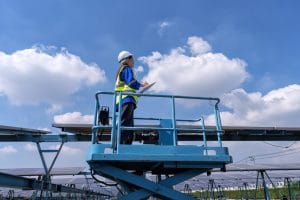

In Queensland there is no separate “working at heights licence”, but there is a clear legal duty: a business must manage the risk of a fall that could cause injury — at any height — so far as is reasonably practicable. This duty sits in the Work Health and Safety Regulation’s falls provisions and the Managing the risk of falls at workplaces Code of Practice.
Key facts at a glance
- The law: Work Health and Safety Regulation 2011 (Qld), Part 4.4 – Falls, plus the Managing the risk of falls at workplaces Code of Practice.
- No blanket “2 metre rule”: the duty to manage falls applies wherever a fall could cause injury — including below 2 m.
- Hierarchy of control: eliminate the fall risk first; use physical controls before relying on harnesses, ladders or procedures.
- Who’s responsible: the business (PCBU) holds the primary duty; workers must follow the system and use equipment correctly.
- SWMS: a Safe Work Method Statement is mandatory for high-risk construction work, including work with a risk of a fall of more than 2 m.
- Training: the nationally recognised unit is RIIWHS204E Work safely at heights — delivered in person by FMS Training (RTO 45189) in Brisbane (Lawnton).
What are the working at heights regulations in Queensland?
Queensland applies the model Work Health and Safety laws. The core obligation sits in the Work Health and Safety Regulation 2011 (Qld), Part 4.4 (Falls), supported by the WorkSafe Queensland guidance and the Managing the risk of falls at workplaces Code of Practice.
The Regulation requires a person conducting a business or undertaking (a PCBU) to manage the risk of a fall from one level to another that is reasonably likely to cause injury. In plain terms: if someone could fall and be hurt, you must act — and the law dictates the order in which you must try the control measures.
Is there a “2 metre rule” for working at heights?
This is the most common misunderstanding. There is no general rule that height safety only applies above 2 metres. The duty applies at any height where a fall could cause injury — people are seriously hurt falling from ladders, trailers, loading docks and trucks well below two metres.
Where 2 metres does matter is in construction work. A Safe Work Method Statement is mandatory for high-risk construction work, which includes work with a risk of a person falling more than 2 metres. And for work at 2 metres or above, lower-order administrative controls (such as training and procedures) are not accepted on their own — higher-order physical controls are required. So 2 metres is a trigger for specific extra requirements, not the point at which safety “switches on”.
What is the hierarchy of control for falls?
The Code of Practice sets out a specific order. You must use the highest-ranked control that is reasonably practicable, and only move down the list when a higher option isn’t reasonably practicable.
| Rank | Control measure | Examples |
|---|---|---|
| 1 (highest) | Eliminate the risk | Do the work at ground level; use extendable tools; assemble on the ground and lift into place |
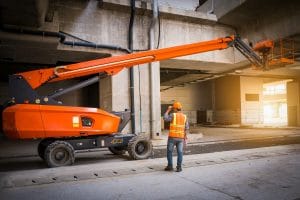
| 2 | Passive fall-prevention device | Scaffolding, guard rails, edge protection, elevating work platforms (EWPs) |
| 3 | Work-positioning system | Travel-restraint system that stops a worker reaching a fall edge |
| 4 | Fall-arrest system | Harness and anchor line, catch platform, safety net |
| 5 (lowest) | Ladders / administrative controls | Fixed or portable ladders, safe work procedures, signage, training |
The point of the ranking is that you can’t default to a harness or a ladder because it’s convenient. If the job could be done from a scaffold or an EWP, that passive control must be used unless it isn’t reasonably practicable.
Who is responsible under the regulations?
The PCBU (the business) holds the primary duty: identify fall hazards, assess the risk, put controls in place following the hierarchy, and maintain and review them. That includes providing the right equipment, inspecting it, and making sure workers are trained and competent.
Workers also have duties: take reasonable care, follow the safe system of work, use the equipment provided correctly, and report damaged gear or new hazards. Designers, manufacturers and suppliers of plant used for height work carry duties too. The primary duty cannot be signed away or shifted onto the worker.
When is a Safe Work Method Statement (SWMS) required?
A SWMS is mandatory before any high-risk construction work starts, and a risk of a fall of more than 2 metres is one of the defined categories. It must identify the work, the hazards and the control measures, and be followed on site — if it isn’t, work must stop until compliance is restored. Even outside construction, documenting your falls risk assessment is the practical way to show you’ve met the duty.
Tip: Equipment is only as good as its inspection record. Harnesses, lanyards, anchor points and EWPs must be inspected before use and maintained per the manufacturer’s instructions. A perfectly rated harness clipped to an unrated anchor point is not a compliant fall-arrest system.
Do I need working at heights training in Queensland?
There is no standalone government “heights licence”, but the law requires workers to be trained and competent for the height work they do, and most sites require evidence of it. The accepted way to demonstrate competency is the nationally recognised unit RIIWHS204E Work safely at heights, which covers identifying fall hazards, selecting and inspecting equipment, safe access, fall-prevention and fall-arrest systems, and emergency procedures.
FMS Training (RTO 45189) delivers Working at Heights (RIIWHS204E) as a hands-on, in-person course in Brisbane (Lawnton), with over 1,300 five-star reviews. For course format, what’s involved and how to book, see our guide to the working at heights ticket in Brisbane. (If your team also enters tanks, pits or vessels, the parallel duty is covered in our confined space regulations guide.)
Frequently asked questions
What are the working at heights rules in Queensland?
Under the Work Health and Safety Regulation 2011 (Qld), a business must manage the risk of any fall that could cause injury, following the hierarchy of control in the Managing the Risk of Falls Code of Practice. There is no separate heights licence, but workers must be trained and competent.
Is the 2 metre rule a legal requirement?
Not as a cut-off for when safety applies. The duty to manage falls applies at any height where injury is likely. The 2-metre figure triggers specific extra requirements in construction: a SWMS is mandatory for a risk of a fall over 2 metres, and administrative controls alone are not accepted at 2 metres and above.
What is the hierarchy of control for falls?
In order: eliminate the risk (work at ground level); use a passive fall-prevention device (scaffold, guard rail, EWP); use a work-positioning system; use a fall-arrest system (harness and anchor, catch platform, net); and only then ladders or administrative controls. Use the highest control that is reasonably practicable.
Do I need a licence to work at heights in Queensland?
No. There is no government-issued “working at heights licence”. The law requires workers to be trained and competent, which is most commonly demonstrated with the nationally recognised RIIWHS204E unit.
When is a SWMS required for working at heights?
A Safe Work Method Statement is mandatory for high-risk construction work, which includes any work with a risk of a person falling more than 2 metres. It must be prepared before work starts and followed on site.
How often should working at heights training be renewed?
The RIIWHS204E unit has no legislated expiry, but most employers and principal contractors require a refresher around every two years to keep competency current. Always check your site’s requirements.
Who is responsible for height safety on site?
The business (PCBU) holds the primary duty to provide a safe system of work, equipment and training. Workers must follow the system and use equipment correctly. The primary duty cannot be transferred to the worker.
Does working at heights training cover EWPs and harnesses?
RIIWHS204E covers fall-prevention and fall-arrest equipment, including harness systems and safe work around elevating work platforms, plus inspection and emergency procedures. Operating some plant may need additional, separate training specific to that equipment.
Related reading: Working at Heights Ticket Brisbane: Course, Cost & Requirements · Confined Space Regulations in Australia